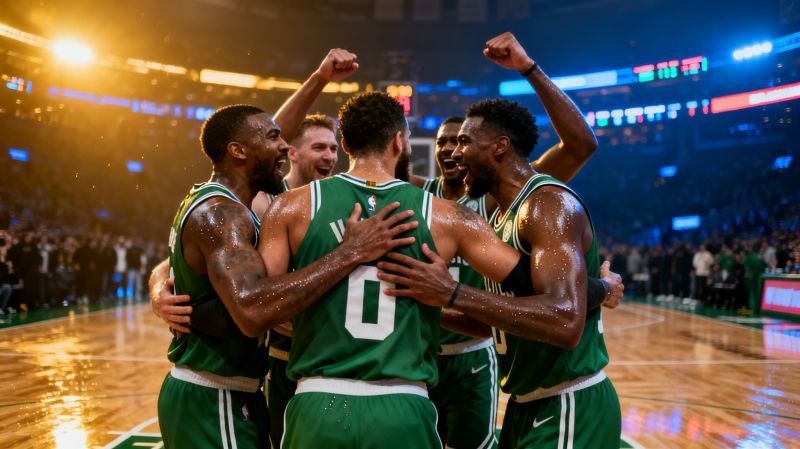
he Celtics forced a Game 7 in the series, and they did it the hard way — on the road, in a building that had spent three quarters treating every Boston possession like a personal insult. What changed in the second half wasn't shot-making. It was the willingness to stop switching every action and start fighting over screens, to make the ball handler see a second body before he saw the rim. For two quarters the offense looked like a group of strangers reading from different scripts: ten turnovers。stagnant isolations, a lot of standing around watching Jayson Tatum work. Boston trailed by nine early in the third, and the deficit had less to do with bad shooting than with a defense arriving a half-beat late on every rotation. By the six-minute mark of the fourth that lead was gone, and the crowd had gone quiet in the specific way arenas do when a closeout party gets cancelled without warning. Nothing about the comeback was elegant. Playoff basketball rarely is.
Tatum finished with 31 points, but the number that mattered more was fourteen — Boston's edge on the glass, most of it manufactured by Al Horford's positioning and a rotating cast of guards who decided, finally, that boxing out was a priority. Jaylen Brown spent long stretches chasing the opponent's best perimeter player and still had legs left to attack closeouts in the last five minutes. Derrick White's two steals down the stretch weren't lucky reads;they were the product of a team that had memorized a favorite action and started jumping it. You could watch the adjustment happen in real time, which is rare in a series that has already been dissected for five games by everyone with a television and an opinion. Tatum's shot-making still carried the heaviest load。but the supporting minutes stopped being a liability.Here's the part that gets glossed over in the morning-after takes: the opponent's shooting regressed。and regression is not the same thing as collapse. They generated clean looks — corner threes, a couple of wide-open catch-and-shoot attempts off dribble handoffs — and simply missed them. Boston shot 12-of-38 from deep and won anyway, which tells you where the game was actually decided: on the defensive end, and at the free-throw line, where the Celtics attempted eleven more. That gap irritates people, and some nights it should. But the fouls were real. Reach-ins, late rotations, a frustrated swipe at the rim from a guard who had been hunted for three straight possessions. Aggression draws whistles;
passive jump-shooting does not, and pretending otherwise is how you lose a series you should have closed. Boston also stopped chasing every offensive rebound, choosing transition safety over second-chance points — a trade that looked conservative at the time and smart by the final buzzer.Coaching deserves credit, though less than the players will get and more than the box score shows. The switch-everything scheme that had been shredded earlier in the series got scrapped in favor of drop coverage on ball screens, with the weak-side wing pre-rotated a step early. Small thing. It changed everything. Boston shortened its rotation, shelved the double-big look for long stretches, and let its best wing defenders survive alone on an island. The pace crawled in the fourth quarter — deliberate, occasionally ugly — because a slow game favors the team with the better half-court defense, and everyone in the gym understood that. The Celtics forced a Game 7 in the series by winning the possessions that never make a highlight reel: the deflection out of bounds, the contested defensive rebound。
the extra pass that drew a foul instead of a shot attempt.Now the pressure flips, which is the strange arithmetic of a seven-game series. A team that was down 3-1 eight days ago suddenly carries all the momentum and none of the expectation, while the team that led has a two-day flight home to explain what happened to its offense in the fourth quarter. Game 7s tend to be decided by turnovers and nerves rather than talent. Boston has the talent. Whether it has the composure is a question nobody can answer until the building gets loud again and the shot clock starts feeling shorter than it is. History is not kind to teams that need one more stop;it never is. The Celtics forced a Game 7 in the series, and in doing so they turned something that felt settled into something genuinely unresolved.